Introduction
Today we submitted written evidence to the Education Select Committee’s inquiry into persistent disadvantage. Pupils who are eligible for free school meals for most of their time at school have some of the lowest outcomes in the system, falling, on average, nearly two years of learning behind their peers by the time they sit their GCSEs. Our evidence draws on the latest national pupil data to show how long-term poverty shapes outcomes from the early years to the end of secondary school, and where policy could make the biggest difference. The full analysis is available on our resources page.
Background
The committee launched its inquiry in the spring, asking how well the education system supports children from families on low incomes over the long term. Most measures of disadvantage used in schools look at whether a pupil is eligible for free school meals at a single point in time, or at any point in the last six years. Those measures group together pupils who spend a few months in poverty with pupils who spend their whole childhood in it. Our previous work has shown that these two groups have very different outcomes, and that the gap for pupils in long-term poverty has widened over the past decade. Identifying this group at school level has also become harder, as transitional protections linked to Universal Credit mean more pupils remain eligible for free school meals than before. Our evidence sets out what the data can and cannot tell us, and how schools and government could target support more effectively.
Data Points
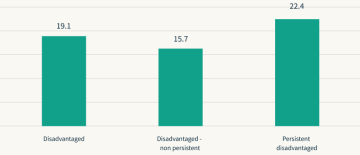
Persistently disadvantaged pupils are 22.4 months behind by GCSE
Around one in ten pupils in England sitting their GCSEs this year has been eligible for free school meals for at least 80 per cent of their time at school. By the end of key stage 4, these pupils are 22.4 months behind their peers who have never been disadvantaged. Pupils who are disadvantaged for shorter periods are 15.7 months behind, which suggests the length of time spent in poverty matters as much as poverty itself. The share of pupils who are persistently disadvantaged has risen steadily, and the gap between them and their peers has grown since 2019.
Analysis
Gaps vary widely by region and ethnicity
The gap is smallest in London and largest in parts of the South East and South West. It is also much wider for White British pupils than for most other ethnic groups: persistently disadvantaged White British pupils are between 22.8 and 27.7 months behind, depending on the region, compared with between 9.4 and 17.4 months for pupils from other backgrounds. Lower take-up of early education, higher rates of persistent absence and greater exposure to teacher shortages all contribute to these differences.
Closing Thoughts
Persistent disadvantage is not the same as short-term hardship, and policy should recognise the difference. We recommended that government weights pupil premium funding towards pupils who have been disadvantaged for longest, extends free early education entitlements to all children in low-income families, publishes school-level data on persistent disadvantage so support can be targeted, and offers incentives for experienced teachers to work in schools with high levels of disadvantage. The committee will hold oral evidence sessions over the coming months and is expected to report next year. We will continue to share our analysis with the committee and with the Department for Education as the inquiry progresses. If you would like to discuss our evidence, please get in touch with our team.